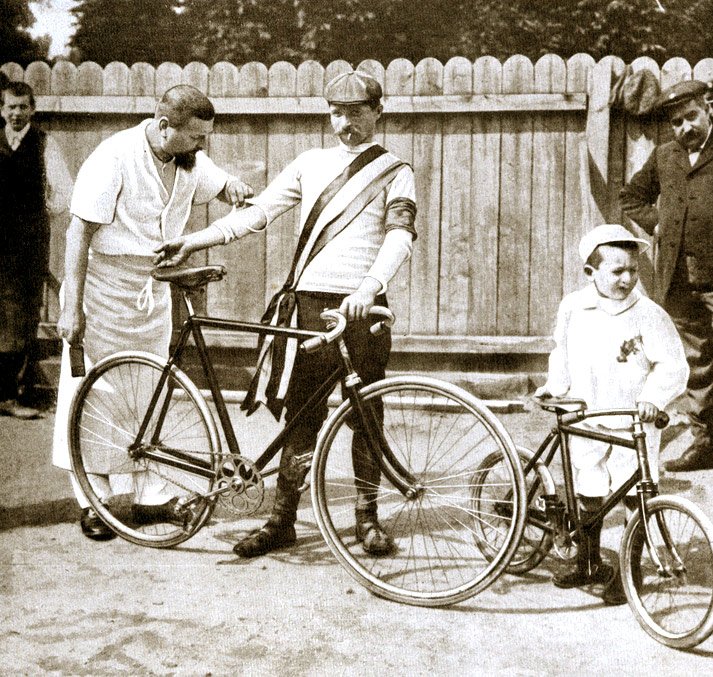

The bike that won the first Tour de France in 1903 weighed roughly 16–18 kg, had one fixed gear and no real brakes. The bikes in today’s peloton weigh about 6.8 kg, shift electronically across 24 or more gears and stop with hydraulic discs. Only the diamond-shaped frame has survived the whole 120-plus years.
The Tour has always been a test bench. Its organisers sometimes banned new technology to keep the race hard, and its riders adopted whatever made them faster the moment the rules allowed it. What follows is that story, era by era.
1903–1936: heavy steel, wooden rims and no derailleurs
Maurice Garin won the first 2,428 km Tour on a fixed-gear steel bike built for stability on rough, often unpaved roads. Its geometry was closer to a sturdy roadster than a race bike, and its rims were wood.
Gearing was crude. Riders soon used a “flip-flop” rear hub with a different sprocket on each side; to change gear they stopped, loosened the wheel and turned it around. A freewheel arrived once the race reached the mountains, and toe clips became standard after 1911.
Riders were also on their own. For the first 20 years any mechanical help earned a time penalty, so spare tubular tyres were carried wrapped around the shoulders. Help from a team was allowed from 1923.
Race founder Henri Desgrange refused to allow derailleurs, even though they already existed. He believed changing gear by hand kept the Tour a test of the rider, not the machine. Alloy rims crept in first: Antonin Magne won in 1934 on Mavic alloy rims, painted to look like wood.
1937–1960s: the derailleur arrives
Rider protests finally won in 1937, and derailleurs were allowed. Every rider used the same model, Oscar Egg’s three-speed Super Champion, and Roger Lapébie won on one. Team cars also appeared that year, and steel frames got lighter as aluminium rims and side-pull rim brakes became standard.
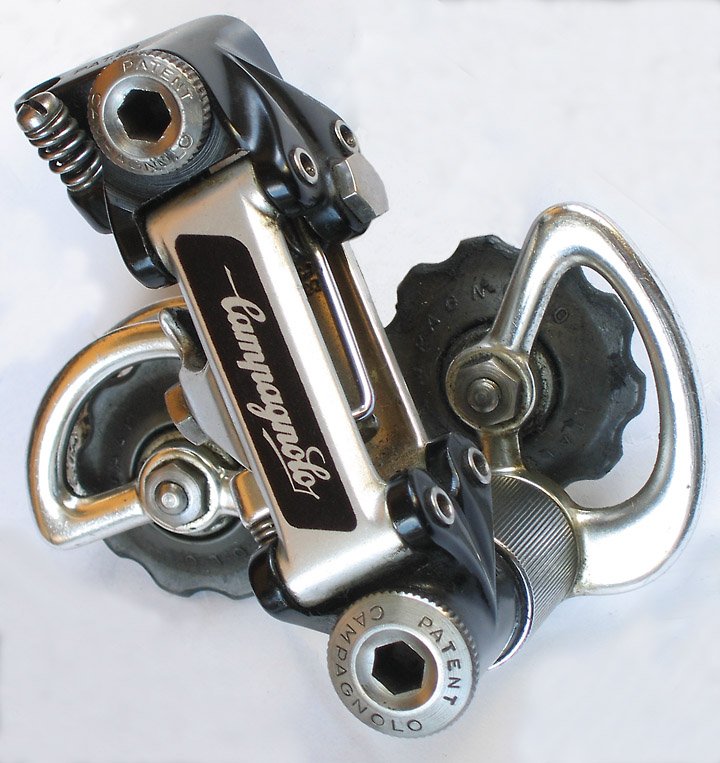
Italian makers then raced to perfect shifting. Gino Bartali won in 1938 with a Vittoria Margherita system and again in 1948 on Campagnolo’s Cambio Corsa, which let riders change gear without removing the wheel. Front derailleurs doubled the range of gears in the late 1940s.
The big leap came in the early 1950s with Campagnolo’s Gran Sport parallelogram derailleur. Its basic design is still how mechanical rear derailleurs work today. For the next three decades the Tour bike was a refined version of the same idea: lugged steel frame, Campagnolo components, shift levers on the down tube.
1970s–1980s: lighter steel, clipless pedals and the first aero tricks
Steel kept getting thinner and lighter. By 1980 Joop Zoetemelk’s winning Raleigh weighed about 10 kg, roughly half of Garin’s bike. Leather saddles gave way to lighter plastic shells with foam padding.
In 1984 Look launched the first clipless pedal, borrowing the idea from ski bindings. Bernard Hinault’s La Vie Claire team made it famous, and toe clips and straps slowly disappeared, though some pros used them into the 1990s.
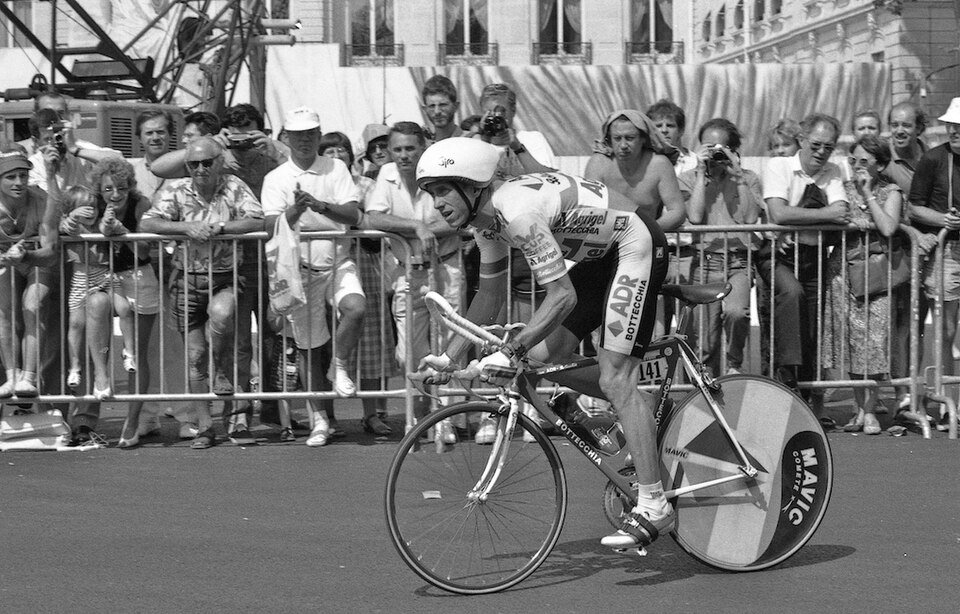
The decade ended with the moment that made aerodynamics matter. In 1989 Greg LeMond used clip-on triathlon bars, an aero helmet and a rear disc wheel in the final time trial. He overturned a 50-second deficit and beat Laurent Fignon by 8 seconds, still the closest finish in Tour history.
1990s: aluminium, carbon and shifting from the bars
The 1990s broke steel’s 90-year hold. Miguel Induráin’s 1995 win started a short aluminium era, which ended with Marco Pantani’s 1998 victory, the last on an alloy frame. Carbon wheels moved from time trials to road stages too: Jan Ullrich won in 1997 on Lightweight wheels with carbon spokes.
Shifting moved to the handlebars. Shimano’s STI (1990) and Campagnolo’s Ergopower (1992) combined brake and gear levers, so riders could change gear while sprinting or climbing out of the saddle. Mavic even tried an electronic derailleur, the Mektronic, in 1992, though it did not catch on.
Time-trial bikes became wild, with Chris Boardman’s monocoque Lotus the best-known example. The UCI reined this in with its 2000 equipment rules, which also set the 6.8 kg minimum bike weight that still applies.
2000s–2010s: the carbon age, electronic gears and disc brakes
Since 1999, every Tour but one has been won on a full-carbon bike. The exception is Óscar Pereiro’s 2006 Pinarello, with a magnesium main frame and carbon rear. Carbon let designers shape tubes freely: Cervélo’s Soloist (2003) was the first road bike with airfoil tube profiles, and “aero road bikes” followed.
The 6.8 kg limit soon became a floor teams had to reach up to. Some climbing bikes were built so light that mechanics added weights to pass the scales.
Shimano’s Dura-Ace Di2 brought reliable electronic shifting in 2009. Cadel Evans won on it in 2011, and Vincenzo Nibali’s 2014 win was the last on mechanical gears.
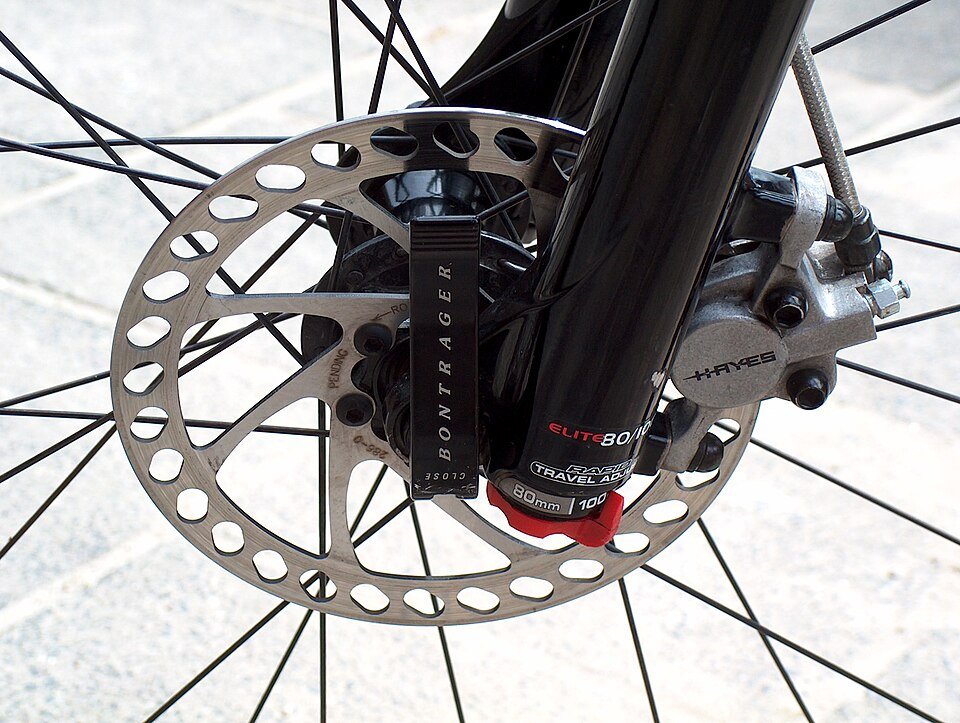
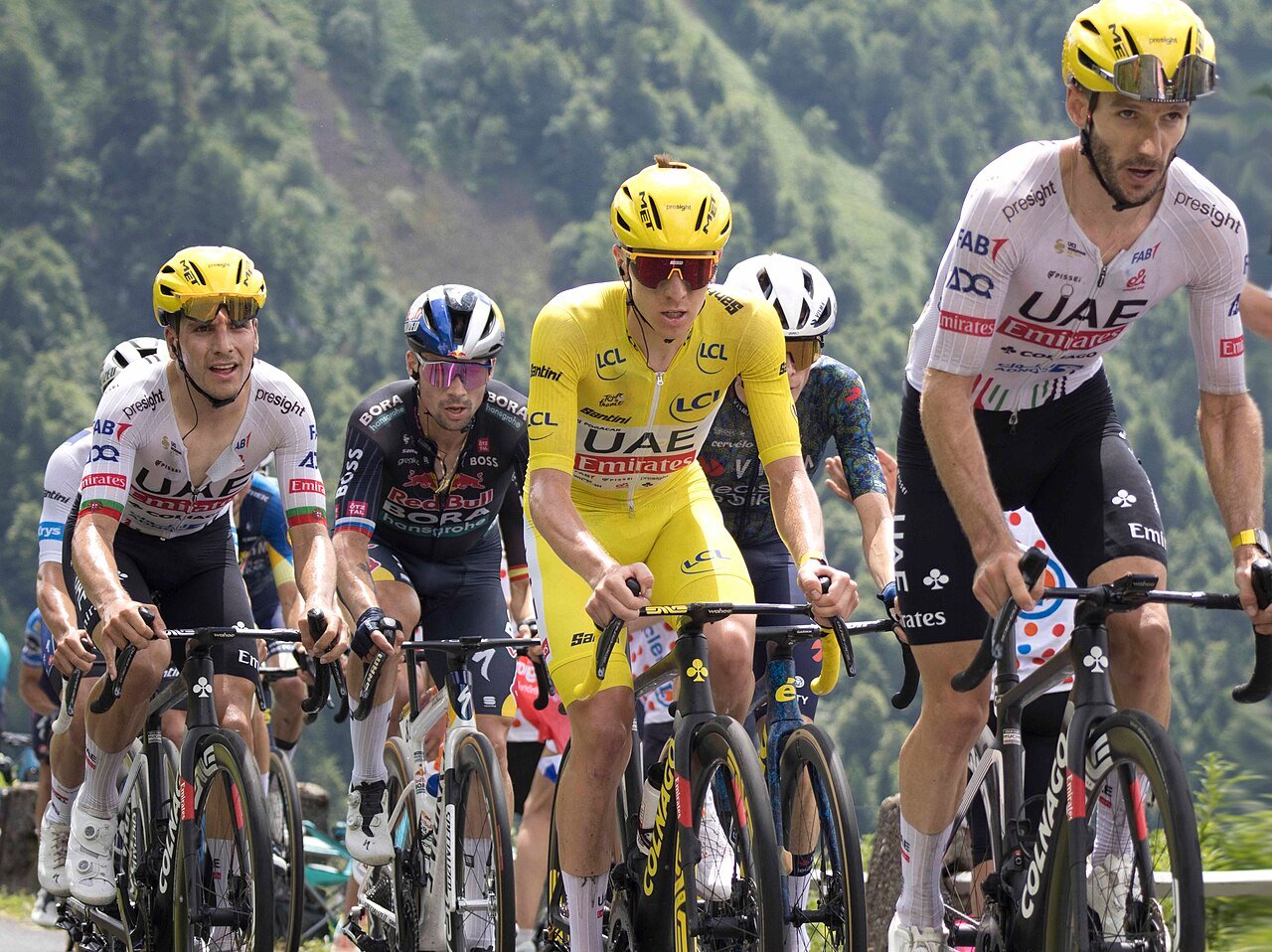
Disc brakes came last. The UCI trialled them in 2015–2017 and fully approved them in 2018. Tadej Pogačar’s 2021 win was the first on a disc-brake bike, though he still switched to rim brakes on some mountain stages to save weight.
2020s: aero everything, tubeless tyres and 13 speeds
Today’s Tour bike is a fully integrated system. Cables and hoses run hidden inside the frame, the bar and stem are one carbon piece, and frame tubes are shaped in wind tunnels. Disc brakes and internal routing first pushed bikes over the limit, but by 2023 the average Tour bike had dropped to 7.45 kg, and top bikes now hit 6.8 kg again.
Tyres changed most visibly. Narrow glued tubulars have largely given way to wider tubeless tyres, which roll faster and puncture less. Drivetrains run 12 or 13 sprockets with two chainrings, sometimes just one on flat stages.
The main design question is now aero versus light. On flat and rolling stages, an 8 kg aero bike often beats a lighter climbing bike. The UCI keeps drawing lines, most recently capping rim depth at 65 mm for 2026, and many riders argue the 6.8 kg minimum is now out of date.
The same shape, a different machine
In 120 years the Tour bike lost more than half its weight, gained some 20 gears and swapped wood and steel for carbon. Yet a 1903 rider would still recognise it: two wheels, a diamond frame, drop bars and a chain. Each leap came when the rules allowed it, and the next fight, over the 6.8 kg minimum, is already under way.
By filip bossuyt from Kortrijk, Belgium – TF241534 Almeida Roglic Pogacar Yates, CC BY 2.0, https://commons.wikimedia.org/w/index.php?curid=153864255Sources
Sources
- 1903 to 2026: how Tour de France bikes have evolved, BikeRadar
- How the Tour de France embraced derailleurs, Velo
- Umberto Dei Milano, 1938, Mariposa Bicycles
- Tour de France bikes history, part one, Siroko
- 1930s–1950s derailleur systems, BikeRaceInfo
- Should the UCI bike weight limit be changed?, BikeRadar
- The UCI weight limit is completely outdated, BikeRadar